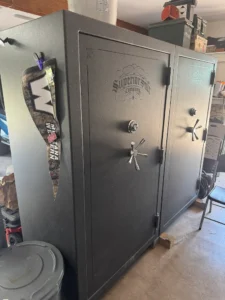
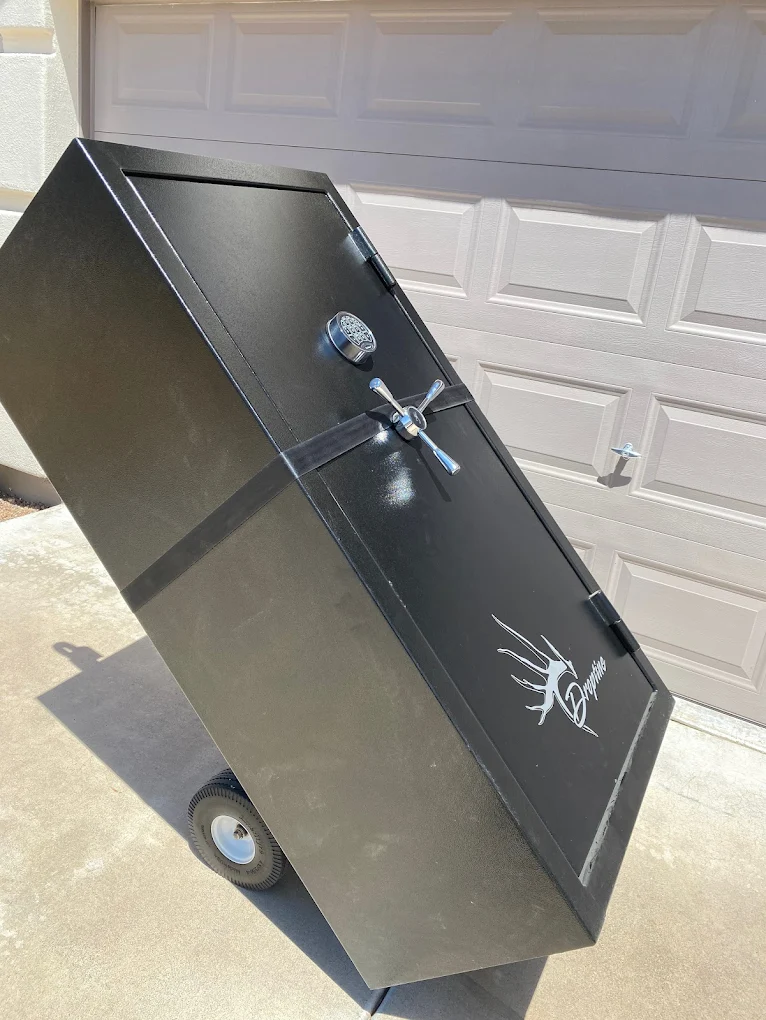
Most residential gun safes have a weight ranging from 300 to 2,000 pounds. The figure that counts on the day you’re moving isn’t the weight at all; it’s the shape. A standard gun safe is 5 to 6 feet tall and has a base only 20 to 30 inches wide, giving it a height-to-base ratio that makes it naturally top-heavy in a way that a short, sturdy document safe or a jewelry box never does. Consumer Product Safety Commission research on injuries from tipping furniture and appliances clearly shows how easily top-heavy items become dangerous once they lose balance. A fully loaded gun safe resting on a hand truck ranks among the most unbalanced objects found in any home.
We at North Valley Locksmith regularly move gun safes throughout the North Valley and have found that in this kind of job, “professional equipment” is not just a sales tactic. It makes the difference between a simple relocation and having to go to the emergency room or ending up with a cracked floor. This article does not serve as a generic checklist for moving safes. Instead, it examines the physical forces at work when you move a tall, narrow, top-heavy gun safe. It also highlights the gap between the tools most homeowners keep in their garages and the proper equipment this task actually requires.
The Physics Problem Nobody Warns You About
Since the height-to-base ratio of a gun safe is much more extreme than that of other kinds of safes, its center of gravity is higher above the ground when compared to the area of the base. It requires only a small amount of tilting to reach the tipping point. A large share of a gun safe’s total weight sits in its door. Thick steel plating and multiple locking bolts create this heavy front section. That uneven weight distribution shifts the safe’s balance even farther forward the moment you tilt it back onto a hand truck. Yet tilting is exactly the step you must take to move it.
What “Walking” a Safe Really Means — and Why It Goes Wrong
You will find homeowners discussing a method called “walking a safe” in online searches. People rock the safe from side to side on its bottom corners. This lets them nudge it forward in small steps without using a dolly or any lifting equipment. It does achieve the result of moving the safe. It is also one of the most frequent reasons why a gun safe ends up on its side or on someone’s foot. Every rock shifts the safe’s full weight onto a single bottom corner. When you work with a top-heavy object, even a small misstep or uneven floor can tip it past the point where you can recover balance. The Moving & Storage Conference at moving.org explains that professional movers always use equipment rated for the exact load weight. They do this because manual methods simply cannot safely move items that weigh this much and have this shape.
DIY Equipment vs. Professional Equipment
| Task | Typical DIY Approach | Professional Equipment We Use | Why It Matters |
| Moving across flat ground | Standard furniture dolly | Rated safe mover’s dolly with locking casters | Small furniture-dolly wheels aren’t rated for 500+ lbs and can seize or fail mid-move |
| Climbing or descending stairs | “Walking” the safe by hand | Continuous-track stair-climbing dolly | Removes the tipping risk inherent to manual walking |
| Lifting to loading height | Manual lifting with straps | Hydraulic toe jack / safe jack | Manual lifting on a top-heavy object risks back injury and dropped loads |
| Securing during transport | Bungee cords | Rated ratchet straps and moving blankets | Bungee cords can snap or release under a sudden stop |
| Protecting flooring | Old blankets or towels | Plywood walk boards and floor runners | Concentrated point-loads from small wheels can crack tile or gouge hardwood |
Interesting Fact: Ratings Vary Widely Among So-Called Gun Safes
Most products marketed as gun safes actually carry a Residential Security Container rating rather than full UL burglary ratings. UL Solutions draws this distinction based on how much force and how long the unit can resist attack. This difference changes the security rating but not the safe’s weight or handling needs. An RSC-rated safe still demands the same careful equipment and proper technique as any higher-rated unit.
It’s a point that’s worth being aware of before you make your next purchase, even though it has no bearing on the way we carry out the move.
Our Process for Moving a Gun Safe Safely
- Pre-move assessment — we evaluate the safe’s weight class, the path from its current spot to the new one, and any stairs or tight turns along the way
- Content and condition check — we confirm the safe is empty and note its starting condition before anything is moved
- Equipment staging — floor protection, ramps, and the correct dolly and strap combination are set up before the safe is touched
- Controlled transport — the safe moves under continuous control using rated equipment, never tilted and shuffled by hand
- Final placement — the safe is set into its new location, ready for leveling or anchoring if you’d like that done in the same visit
North Valley’s Gun-Owning Community
In the North Valley there is a strong tradition of responsible firearm ownership. A trend is in part due to the presence of the Ben Avery Shooting Facility, the state-operated range located in North Phoenix, which attracts shooters from all over the Valley. It is for this reason that work involving gun safes forms a consistent part of our activities. More households in the North Valley have one than the average for the entire metro area. A number of them are upgrading to bigger or higher-rated models as their collections increase. We design our entire fleet of equipment specifically for this scenario. We do not treat moving gun safes as an unusual or occasional task.
The North Valley Locksmith Difference
A gun safe does not just weigh a great deal. Its design also makes do-it-yourself moving extremely dangerous. You risk harming yourself, damaging the safe, and ruining your floors. If you are planning to move and are considering using a hired furniture dolly, it’s a good idea to give North Valley Locksmith a call first. You can arrange a free visit and get a quote for the moving of your gun safe by contacting them today.
Attempting to move a heavy gun safe without specialized gear puts your home, flooring, and safety at serious risk. Our team uses motorized stair climbers, heavy-duty floor protection, and specialized rigging equipment to navigate tight turns and steep stairs cleanly and safely—contact North Valley Locksmith to book your professional gun safe move today.
Frequently Asked Questions
Should I remove firearms and ammunition from the safe before moving day?
Certainly—we ask that you remove all firearms, ammunition, and items before our arrival. Not only to reduce the safe’s weight, but also so you have direct control over your firearms rather than having them transported inside a safe that is being tilted and moved. It also lets us move the empty safe more smoothly. Items loosely inside a fully loaded gun safe can shift the safe’s balance during transport. The National Shooting Sports Foundation provides general consumer information on storing and handling firearms. For any matter with legal consequences in your case, we recommend consulting the Arizona Department of Public Safety or a qualified lawyer rather than having us give that advice.
What is the cost of moving a gun safe in the Phoenix area?
The cost will vary according to the weight class of the safe, the distance between its present position and the new location, whether stairs or more than one floor have to be climbed, and if special equipment such as a stair-climbing dolly or a toe jack is required to get through tight spaces. Moving a basic 400-pound gun safe across a one-storey house costs considerably less than transporting a heavy, high-security 1,800-pound unit to a gun room on the second floor. Since each home has a different layout, we offer a free walkthrough and a definite quote instead of a fixed rate per safe, which doesn’t account for access difficulty.
Is there a maximum weight for the gun safes you can move?
We frequently handle gun safes weighing about 300 to 2,000 pounds using stair-climbing dollies, safe jacks, and rated straps. This covers the vast majority of residential gun safes on the market. If the safes are exceptionally heavy—such as commercial-grade vaults—we assess each job individually to ensure we have the right equipment and the right number of crew members before proceeding. If you don’t know what your safe weighs, the manufacturer’s specification sheet or a label on the back of the safe will usually list the weight. We’ll be happy to help you find that information over the phone.
What if my gun safe does not fit through a doorway or down a hallway?
Certain gun safes, particularly those that are taller and of the premium type, end up being either wider or taller than a standard interior doorway when you take into account the space needed to swing the door around a corner. When such situations arise, we consider alternatives such as temporarily taking down the door or door frame, going through the garage or a side entrance rather than the main hallway. In rare instances, arranging partial disassembly of removable parts like the door or the top panel. We always review this during the first walkthrough, not on moving day. There are no surprises when the moving team and their equipment arrive on site.
Do you offer insurance or liability coverage when you are moving?
North Valley Locksmith has liability insurance that covers the part of moving a gun safe that involves physical handling and transport and protects against damage to your equipment or property caused by our equipment or methods. Although your home insurance policy might deal separately with firearms or valuable items that are in transit, it’s a good idea to ask your insurance agent about this beforehand if you want an extra sense of security. We also advise taking photographs of the safe’s condition and its surroundings before we start, so you have a clear reference if any documentation is needed later.
How many days ahead should I book my gun safe move?
For a typical single-safe move, we can usually meet requests within a few days. Still, if you want to schedule further in advance, we will have more flexibility in matching the right equipment and crew size to your safe and layout. For moves involving several safes, difficult stair access, or the need to coordinate with a larger household move, we recommend at least a week’s notice. However, if your situation is truly urgent, please call us directly—we can rush requests when our schedule permits.
Will you re-level or re-secure the safe once it’s in its new position?
Yes, when the gun safe has been placed in its new position, we check that it is level and, if you want, secure it to the floor or wall with hardware suitable for that surface, be that a concrete slab or a wooden subfloor. A gun safe that is not anchored, even one that is heavy, can still be tipped over or pulled by someone who has plenty of time and uses enough leverage, so re-securing it is an important aspect of properly completing the job rather than simply putting it down and departing. We also do a final inspection of the door swing and lock mechanism to make sure nothing shifted out of alignment during the move.
Do you provide service to areas outside Phoenix, such as Glendale, Peoria, or Scottsdale?
Yes — while a large share of our gun safe moves happen in North Phoenix communities near Ben Avery Shooting Facility and the broader North Valley, we also regularly serve Glendale, Peoria, Scottsdale, and other parts of the greater Phoenix metro. Our equipment and process are identical regardless of neighborhood, so distance from North Phoenix isn’t a barrier to getting the same level of care. If you’re outside our typical coverage area, give us a call, and we’ll let you know directly whether we can take on the job.
See also: Why Gun Safe Moving Should Always Be Left to Professionals in Phoenix, Home Safe vs. Gun Safe Installation: What Phoenix Homeowners Should Know