For most of the last decade the Phoenix metro area has been one of the fastest-growing of the large metro areas in the country, as shown by the population figures from the U.S. Census Bureau; this implies that a large number of new homeowners in the Valley are buying a house here for the first time without having previously lived in a place that had a basement. This fact is more important than many people realize, since almost all of the general “how to install a home safe” guides available online assume the presence of a basement slab, a cool utility room, and a climate that doesn’t regularly reach 115°F in the shade.
At North Valley Locksmith, we install and secure safes in homes across the North Valley each week. The most common mistake we see is not a low-quality safe but a high-quality safe placed in the wrong spot, installed the wrong way, or selected without considering the local climate. You can buy a UL-rated safe and place it in a garage corner or secure it with improper hardware. That choice does not just hurt performance. In the Valley of the Sun, it can actually shorten the safe’s lifespan and damage the documents stored inside.
Why Phoenix’s Desert Foundation Changes the Installation Game
Builders construct most homes in the Phoenix area on concrete slabs instead of adding basements, unlike in most other parts of the country. Caliche causes this difference. Caliche is a dense, cement-like soil layer found across much of the Valley. It makes digging basements difficult and expensive. The Arizona Geological Survey has well documented this condition. So, if you’re coming from a state where the usual recommendation is to ‘bolt it to the basement floor,’ that advice won’t apply to a typical house in Phoenix.
This is not a disadvantage. Slab foundations actually work very well for anchoring safes when you use the proper hardware. The real concern lies elsewhere. You must plan the installation method from the very start for slab-on-grade construction. You should not adjust the setup later based on guidance meant for other home types.
The Heat Factor: Why Placement Matters More Here Than Anywhere Else
Phoenix has numerous days each year when the temperature goes above 100°F, and the National Weather Service’s Phoenix forecast office monitors this situation every summer. Temperatures inside a garage can climb far higher than outdoor air during the warmest months. This creates a real concern for two key reasons. Fire-rated safes rely on a moisture-releasing gel liner that works effectively only up to a specific temperature limit. Digital keypad batteries also degrade much faster when exposed to sustained heat. Humidity shifts during the monsoon season add further risk. A poorly placed safe can suffer heat damage and condensation-related rust within a single year.
| Placement Zone | Suitability | Why |
| Interior closet on slab | Best | Stable temperature, easy slab anchoring |
| Primary suite closet | Best | Stable climate, added privacy and access control |
| Interior home office | Good | Stable climate, convenient daily access |
| Exterior-facing wall | Caution | Heat transfer from outside wall raises interior safe temperature |
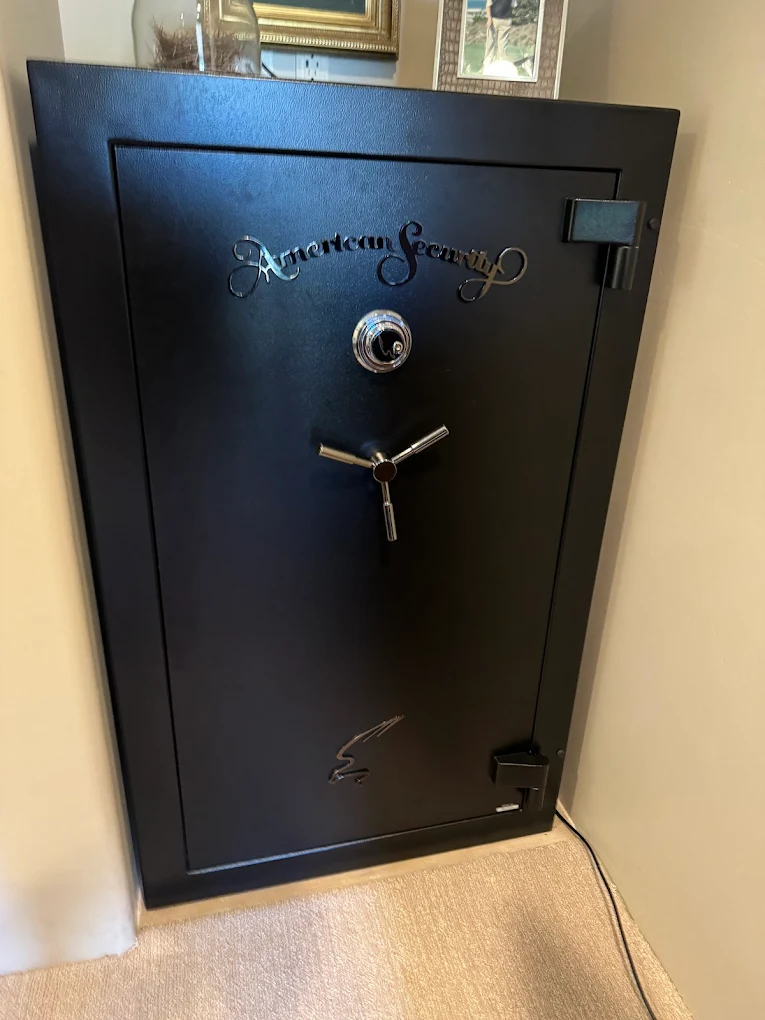
| Garage | Poor | Extreme summer heat degrades fire lining and lock batteries |
| Attic | Poor | Highest heat exposure in the house, plus difficult access |
Anchoring 101: Concrete Slab vs. Wood Subfloor
Most ground-floor rooms in Phoenix rest on a concrete slab. However, builders typically frame second-story rooms with wood. These two surfaces require entirely different anchoring hardware.
- Concrete slab: requires masonry wedge anchors or sleeve anchors rated for the safe’s weight, drilled to a specific depth for full holding strength
- Wood subfloor: requires lag bolts driven into floor joists (not just the subfloor sheathing), which means locating joists precisely before drilling
- Mixed installations (safely positioned over a slab-to-wood transition, common in additions) require assessing both surfaces separately
- Never rely on adhesive-only mounting or drywall anchors for a safe of any real weight — neither is rated for the load or the security requirement
Our Installation Process
- Placement consultation — we evaluate your proposed location for climate exposure, slab vs. subfloor, and daily accessibility
- Surface confirmation — we identify whether we’re anchoring into slab, joists, or a mixed surface
- Positioning and leveling — the safe is set and leveled before any permanent anchoring begins
- Anchoring — hardware is selected and installed to match the surface and the safe’s weight rating
- Seal and clearance check — for fire-rated units, we confirm door seals and ventilation clearances are intact after installation
North Valley Neighborhoods We Serve Most Often
We have installed safes in various areas throughout the North Valley, such as Desert Ridge, Deer Valley, Norterra, Moon Valley, Sunnyslope, Anthem, Cave Creek, and New River. In many of these communities—especially among the more recent master-planned developments situated along the Loop 101 and Loop 303 corridors—there is a high proportion of homeowners who have moved in from outside the state, a group who are most likely to base their decision to install a safe on advice from the basement era that no longer applies in this area. Additionally, we receive a reasonable number of service calls related to monsoons in the more remote parts of the North Valley, where dust from seasonal haboobs can eventually get into a safety that has an improperly sealed exterior wall.
The North Valley Locksmith Difference
A safe’s security depends fully on its placement and installation method. Phoenix’s unique climate and building styles mean we can offer far less general guidance than most homeowners expect. If you’re new to living in the desert or are finally getting round to securing the safe that has been sitting in your closet, we’ll assist you in positioning and installing it so that it will really prove durable in this area. Call North Valley Locksmith now to arrange a free in-home consultation.
An unanchored or improperly installed safe leaves your Phoenix home vulnerable to tipping hazards, post-slab damage, and swift removal during a break-in. Protect your property, family, and high-value assets with professional heavy-equipment transport, precise leveling, and certified subfloor bolt-down services—contact North Valley Locksmith to schedule your safe installation today.
Frequently Asked Questions
What fire resistance rating or size should I seek when I buy a safe before installing it?
The size and fire resistance you need will depend on the type of items you’re trying to protect and how much you have—for example, a small safe for jewelry and family heirlooms will have different requirements from a home office safe designed to store passports, deeds, and a backup drive. Manufacturers generally assign fire ratings using both temperature and time. Common examples include 350°F for 30 minutes or 1200°F for one hour. These ratings show how long the safe’s interior stays cooler than the temperature at which paper chars. UL Solutions publishes the standard testing methods that most manufacturers use to test their products. We will gladly address any questions you have about size and rating options before you buy. Choosing the safe first makes it much easier to plan its installation location. You will also avoid costly adjustments later.
Do I need a permit to install a safe in my Phoenix home?
In most instances, when you bolt a residential safe to an existing slab or subfloor, no building permit is needed because such an action is considered to be a fixture installation and not a structural alteration—although this may vary if the work involves cutting into a wall, changing the flooring, or constructing a custom vault room. The Planning & Development Department of the City of Phoenix keeps up to date with the permit requirements for residential projects, so it’s advisable to give them a quick inquiry if your installation goes beyond a simple freestanding or built-in safe.Local jurisdictions set the permit rules for homes in Scottsdale, Peoria, Glendale, and other North Valley communities. That is why we always verify the specific requirements for each area before we begin any larger installation projects.
What does it cost to have professionals install my safe?
The cost will vary according to the weight and dimensions of the safe, the type of anchoring surface (a concrete slab is usually simpler to deal with than a wooden subfloor on the second storey), and whether the installation is a simple bolt-down or requires extra work such as building a custom closet. Installing a small jewelry safe in a ground-floor closet is a far smaller job than fitting a large gun safe to a second-storey primary suite. Since each house has a different layout and foundation, we offer a free in-home consultation and a definite quote instead of giving a fixed price that does not take into account the details of your particular installation.
Can I have a safe that I already own installed, or do I have to buy a new one from you?
We install safes regardless of where you acquired them. You may have purchased your safe online, inherited it from a relative, or bought it secondhand. We work with all such units. Our first step is to check its condition: we examine the locking mechanism, the hinges, and the bolt work to make certain that all of these parts are working properly before we secure it in position, since installing a safe that has an existing mechanical problem would just mean locking that problem into your house. If our inspection finds an issue, we will document it and explain your repair and replacement options. We will discuss these choices with you before we move forward.
Does bolting a safe down make it truly more secure than leaving a heavy freestanding unit unbolted?
Yes, in most cases. A determined burglar with enough time and proper tools can tip, drag, or load a freestanding safe onto a hand truck and remove it entirely from your property. They can then work to force it open elsewhere without the pressure of completing the break-in inside your home. Bolting a safe firmly to a slab or wall studs removes this risk. Any attempt to open it must happen on site. Noise and time constraints then fall entirely on the intruder. Many homeowners buy safes rated for maximum security yet set them unanchored on closet floors. That choice completely negates a key benefit they paid to obtain.
After you install the safe, will you set the combination and then show me how to use it?
Certainly—after you’ve secured your safe in position, we will enter your first combination or program your electronic keypad and then go through the process of how to use it, covering battery replacement for digital locks and the procedure for backup keys if your model has that feature. Before we leave, we carry out a few open and close cycles to check that the lock works smoothly in real conditions and not just on paper. If anybody else in your household would like a walkthrough, we’d be happy to show them as well.
What is the way of telling whether the floor or wall of my closet is able to carry the weight of a safe?
For safes installed on a concrete slab, which describes the vast majority of ground-floor rooms in Phoenix-area homes, weight is rarely a concern since a properly poured slab supports far more than even a large safe. The bigger question comes up with second-story installations over a wood-framed subfloor, where we assess joist spacing and direction to confirm the load is distributed safely rather than concentrated on a single unsupported span. If we have any doubt about a second-floor location, we’ll recommend either reinforcing the area first or relocating the safe to a ground-floor room rather than risk a floor that can’t handle the long-term load.
Does installing a safe affect my homeowners insurance premium or coverage?
Some insurance carriers offer reduced premiums or higher coverage limits for scheduled valuables — like jewelry, firearms, or collectibles — when they’re stored in a UL-rated, properly anchored safe, since it lowers the insurer’s risk of a total loss from theft. Specifics vary by carrier and policy, so ask your agent directly whether professional installation could qualify you for a discount or higher itemized coverage; the Insurance Information Institute has general background on how insurers evaluate valuables’ coverage. We’re also happy to provide installation documentation, including the anchoring method and safe specifications, if your insurer requests proof for a claim or policy adjustment.
See also: Why Luxury Homeowners in Phoenix Trust Professional Safe Installation Services, Choosing the Best Location for Your Home Safe During Installation