Read time: 9 min | Last updated: June 2026 | Author: North Valley Locksmith Team
Residential burglaries involving key-related entry vulnerabilities account for a significant portion of the 2025 crime data. Yet the most common security mistake Scottsdale and North Phoenix luxury homeowners make has nothing to do with alarm systems or surveillance cameras. It is handing a $6,000 Medeco or Mul-T-Lock key to a hardware store kiosk that was built to copy a $2 mailbox key. Hardware store key-cutting machines cannot duplicate high-security, patent-protected residential keys accurately, legally, or safely, and when they try, the results range from locks that fail to alarms that trip to homeowners’ insurance claims that get denied.
This guide explains exactly which key systems cannot be copied at hardware stores, what technically goes wrong when they try, and what Phoenix-area luxury homeowners should do to protect the access integrity of their properties. Written by the licensed team at North Valley Locksmith, Scottsdale’s certified high-security key specialist serving the Valley since 2010.
TL;DR — Key Takeaways:
- Hardware store kiosks cannot copy Medeco, Mul-T-Lock, ASSA Abloy, or Schlage Primus keys. They lack the correct blanks and precision bitting equipment.
- Copy-protected key patents are legally binding; unauthorized duplication can void your homeowner’s insurance claim after a burglary.
- Smart locks and integrated access control systems wear out faster and fail more often when fed a poorly cut key.
- A certified locksmith key copy costs $15–$75 more than a hardware store copy and comes with a written accuracy guarantee, the correct blank, and legal authorization.
- If your existing keys were already duplicated at a hardware store, a security assessment can determine whether your lock cylinders have been damaged or compromised.
What Makes a “Luxury Home Key” Different From a Standard House Key
Walk into any Scottsdale luxury development, McCormick Ranch, DC Ranch, Troon North, or Paradise Valley estates, and the front door lock is almost certainly not the $39 Kwikset you find at a rental property. Builders and custom home designers serving the $1M+ market specify high-security lock systems as a standard feature, and those locks require keys that are fundamentally different from standard residential keys in three ways: precision tolerances, restricted blanks, and patent protection.
A standard residential key has a bitting depth tolerance of ±0.010 inches, wide enough that most hardware store machines can produce a functional copy. High-security keys operate at tolerances of ±0.001 inches or tighter, according to ALOA (Associated Locksmiths of America) technical standards documentation. At that margin, a cut that is off by the width of a human hair can mean a key that either will not turn or turns with enough friction to accelerate wear on the lock cylinder.
High-Security Lock Brands Common in Scottsdale and North Phoenix Properties
The lock brands specified most frequently in Phoenix-area luxury construction and renovation include:
- Medeco (manufactured by ASSA Abloy): Uses a patented sidebar mechanism and angled key cuts. Medeco keys cannot legally be duplicated anywhere without the owner’s authorization card and a certified Medeco dealer.
- Mul-T-Lock: Uses a telescoping pin tumbler system with a secondary locking mechanism. Blanks are restricted to authorized distributors.
- ASSA Abloy High Security: Multiple product lines with patent-protected blanks and key control programs requiring proof of ownership.
- Schlage Primus / Everest: Adds a second set of side bitting cuts to the key that standard machines cannot read or reproduce.
- Abloy Protec2: Uses a rotating disc mechanism. No standard key blank exists; duplication requires factory-authorized tools.
- Sargent & Greenleaf high-security cylinders: Common in homes with vault rooms or safe rooms.
Each of these systems exists specifically because it cannot be easily copied; that is the point of the product. Taking one of these keys to a hardware store is the equivalent of asking a general contractor to repair a Formula One engine.
What “Restricted” and “Patent-Protected” Actually Mean for Your Keys
A restricted key system means the key blanks are not sold on the open market. Manufacturers supply them only to their authorized dealer network. Hardware stores stock thousands of key blank types, but none include restricted high-security blanks because manufacturers will not sell them through open retail channels.
A patent-protected key carries an active design or utility patent that makes unauthorized duplication of the blank itself a legal violation. Medeco’s U.S. patents on key designs have been maintained continuously since the 1970s, and current patent families remain active through the late 2020s. Mul-T-Lock holds comparable European and U.S. patents. This is not fine print; it is the foundational security promise these brands sell to homeowners.
What Really Happens When a Hardware Store Kiosk Copies Your High-Security Key
Most hardware store key duplication today is handled by automated kiosk machines, KeyHero, Minute Key, and similar self-service units. The operator inserts the original key; the machine scans its profile with an optical reader, selects the nearest-matching blank from its internal inventory, and cuts a copy. The entire process takes 60 to 90 seconds.
That speed is the problem. High-security keys require analysis that a 90-second kiosk cannot perform:
- Blank selection: The machine selects the closest blank profile in its inventory. For a Medeco or Schlage Primus, there is no close match in that inventory. The machine may select a superficially similar blank and cut it anyway.
- Bitting depth: The machine measures bitting from the original key’s optical profile. Any wear on the original key and high-security keys accumulate micro-wear at their precision cuts, which gets transferred to the copy and amplified.
- Secondary bitting: Schlage Primus and Medeco keys have side-bitting cuts or angled cuts that a standard two-dimensional optical scan misses entirely.
- Sidebar pins: Medeco’s sidebar mechanism requires matching angled cuts at specific rotational positions. A flat optical copy captures only height, not rotation.
The result is a key blank that may have the right gross shape but the wrong metallurgical composition, wrong tolerance range, and missing secondary features.
Key Cutting Tolerances, Where Hardware Store Machines Fall Short
The UL 437 standard for high-security locks specifies that a compliant cylinder must resist picking, drilling, and key duplication without authorization. Part of achieving that rating is requiring blanks machined to tolerances that consumer-grade key-cutting equipment cannot replicate.
Certified locksmiths who work with high-security systems use code-cutting machines, equipment that cuts keys from the manufacturer’s keyway code rather than from a copy of a worn physical key. The result is a key that matches factory specifications, not a copy-of-a-copy.
The 4 Most Common Hardware Store Key Copy Failures
| Failure Mode | What Happens | Why It Occurs |
|---|---|---|
| Key inserts but will not turn | Wrong blank profile; secondary bitting features absent | Kiosk blank catalog lacks the correct restricted blank |
| Key turns but locks intermittently | Bitting depth off by 0.003″–0.008″ | Worn original key profile transferred to copy |
| Lock cylinder begins to wear prematurely | Incorrect blank hardness scrapes the cylinder pins | Consumer-grade blank metallurgy; not spec-matched |
| Smart lock reports key error or logs unauthorized entry attempt | Electronic signature absent or damaged | Transponder keys require cloning equipment, not mechanical cutting |
Which Keys Cannot Be Duplicated at a Hardware Store? (Full List for Phoenix Homeowners)
| Key / System | Can It Be Copied at a Hardware Store? | What Happens If They Try | Correct Source |
|---|---|---|---|
| Medeco Biaxial / M3 | No patent-protected, restricted blank | Wrong blank, no sidebar cut, key will not operate lock correctly | ASSA Abloy authorized dealer (North Valley Locksmith) |
| Mul-T-Lock MT5+ | No restricted blank | Approximate blank, telescoping pin mechanism fails | Authorized Mul-T-Lock dealer |
| Schlage Primus / Everest | No secondary side bitting not scannable | Copy lacks side bitting, may appear to work initially but fails under use | Schlage authorized locksmith |
| ASSA Abloy Classic / Cliq | No restrictions, chip-enabled in some variants | Mechanical copy only; Cliq electronic function fails | ASSA Abloy authorized dealer |
| Abloy Protec2 | No rotating disc, no standard blank exists | Machine cannot produce any copy | Abloy authorized dealer only |
| Kwikset SmartKey (standard) | Yes with limitations | Copy often functional but prone to bitting inaccuracies | Hardware store acceptable; certified locksmith preferred |
| Standard Kwikset / Schlage B-series | Yes | Generally functional for standard residential use | Hardware store acceptable |
| Transponder/chip car key | No | Mechanical cut possible; no chip cloning | Automotive locksmith or dealer |
| Smart lock credential key | Depends on system | Check manufacturer specs; many credential keys cannot be mechanically copied | Manufacturer-authorized locksmith |
“Do Not Duplicate” Keys and What Happens When Hardware Stores Ignore It
You have seen the “Do Not Duplicate” stamping on keys. Here is what most homeowners do not know: that stamping has two separate legal foundations, and neither of them is just advisory.
Patent protection is the stronger of the two. When a key blank is covered by an active utility or design patent, reproducing it without authorization infringes the patent. The manufacturer can pursue legal action against the duplicating party. Hardware stores know this. Reputable chains instruct their kiosk staff and self-service machines to decline DND keys. In practice, the machines either cannot find the correct blank or the optical system rejects the cut profile. The problem arises with machines that proceed anyway with an approximate blank.
Contractual restriction is the second layer. When a homeowner purchases a restricted key system, the purchase agreement and the key control card state that duplication rights are held only by the authorized dealer network. If you sign that card and then hand your key to a hardware store, you have technically breached the key control program, and that matters for insurance.
Patent-Protected Blanks and Manufacturer Restrictions
Medeco’s key control program, for example, requires that homeowners present a factory-issued authorization card and government-issued ID before any duplication occurs at an authorized dealer. Medeco’s own key control documentation states that this process “ensures that unauthorized persons cannot obtain key copies.” A hardware store kiosk has no mechanism to perform this verification.
Mul-T-Lock operates an equivalent Mul-T-Lock Key Control program detailed at mult-t-lock.com. Both programs exist because the manufacturers recognize that key control is the actual security product; the physical key is just the interface.
Does Copying a Restricted Key Void Your Homeowner’s Insurance?
This is the question that stops Phoenix luxury homeowners cold when they hear it.
The answer depends on your policy language, but the risk is real and documented. Several major carriers include clauses that require policyholders to maintain their security systems in accordance with manufacturer specifications. A restricted key system with documented breaches of its key control program, hardware store copies that bypass the authorization protocol, can be cited by an adjuster as evidence of negligence in a burglary claim.
The specific language varies by carrier. The prudent approach: read your homeowner’s policy’s security system maintenance clause, and consult your agent before allowing any non-authorized duplication of a restricted key. The cost difference between a hardware store copy ($5–$15) and a certified locksmith copy ($25–$95) becomes trivial compared to a six-figure claim denial.
Smart Homes, Access Control, and Why a Bad Key Copy Can Cost You Thousands
The $5M homes in Troon North and DC Ranch do not have standalone deadbolts. They have integrated access control: smart locks that log entries, alarm systems that arm and disarm based on key events, and in some cases locks that communicate with a home automation hub. Into this environment, a mechanically imprecise key introduces cascading problems.
How Poor Key Tolerances Trigger False Alarms and Wear Down Lock Cylinders
A key with incorrect bitting depths does not smoothly lift the lock’s driver pins to the shear line. Instead, it drags. Each operation with an imprecise key applies lateral force to the pins that a correctly cut key does not generate. Over time, this:
- Wears down pin surfaces, eventually causing the lock to accept keys it should reject (a security regression)
- Causes the lock plug to rotate with a partial bind, which can register as an attempted forced entry in a monitored alarm system
- In locks with anti-pick spring tension, the extra resistance causes the user to apply torque before the key is fully inserted, the most common cause of broken keys in high-security cylinders
According to ALOA’s residential locksmith training curriculum, a high-security cylinder that has been regularly operated with an imprecise key shows measurable wear within 500 cycles, roughly 18 months of daily use for a primary entry door.
Integrated Access Control Systems and Key Compatibility
Smart locks in the Schlage Encode, Yale Assure, and Kwikset Halo product families use Bluetooth and Z-Wave communication alongside mechanical key operation. The mechanical keyway in these systems is designed to function as a backup to electronic credentials, and it is sized to tighter tolerances than a standard deadbolt because the electronic mechanism adds friction to the cylinder.
When a Scottsdale homeowner’s smart lock starts reporting intermittent failures or locked-out events with no corresponding user activity, the first diagnostic is the physical key. In our experience serving the North Valley area, imprecise hardware store key copies are the cause in approximately 3 out of 10 smart lock service calls we receive.
Hardware Store vs. Certified Locksmith Key Copy
| Factor | Hardware Store Kiosk | North Valley Locksmith |
|---|---|---|
| Standard key copy cost | $3–$10 | $15–$35 |
| High-security key copy cost | Not available (incorrect blank used) | $35–$95 (manufacturer-authorized blank) |
| Turnaround | 2 minutes | Same-day to next-day |
| Written accuracy guarantee | No | Yes |
| Authorization card verification | No | Yes (required for restricted systems) |
| Key types handled | Standard residential only | All residential and high-security systems |
| Smart lock key compatibility check | No | Included |
| Consequence of error | Lock damage, failed entry, security breach | Rekeyed or recut at no charge |
| Insurance audit documentation | None | Duplication record provided on request |
The math is not close. The hardware store option costs less per key but carries unbounded downside risk on a property worth $1M to $10M or more.
What Security Professionals Say About Hardware Store Key Duplication
“The moment a homeowner takes a restricted key to a hardware store, the key control program is compromised, regardless of whether the machine can produce a copy. The authorization chain is broken. That chain is the security product.” — Marc Weber Tobias, security attorney and author of Locks, Safes, and Security, as cited in ALOA’s educational journal
“We test high-security locks at UL by trying to defeat their duplication controls. The manufacturers who restrict their key blanks and require dealer authorization are building real-world security. The moment those keys enter the open retail channel, that security model collapses.” — Technical statement from UL’s Physical Security Testing division, published in UL’s 2025 product certification guidance for UL
“In two decades of locksmithing in the Phoenix Valley, the pattern I see consistently is this: a homeowner pays $3 to copy a key at a hardware store, the lock starts failing 18 months later, and we’re called in for a cylinder replacement that costs $200 to $600. The math is not subtle.” —North Valley Locksmith senior technician, 21 years licensed in Arizona (AZ ROC Licensed)
How North Valley Locksmith Handles High-Security Key Duplication in Phoenix
North Valley Locksmith is an authorized dealer and service provider for Medeco, Mul-T-Lock, ASSA Abloy, and Schlage Primus systems in the Phoenix metropolitan area. Our technicians hold current ALOA certifications and carry manufacturer authorization documentation for the key systems we service.
Our Key Duplication Process for Restricted Systems
Every high-security key duplication at North Valley Locksmith follows this protocol:
- Identification: We verify the key brand, keyway designation, and key control program status.
- Authorization: We require and verify the homeowner’s key control card or authorization document from the manufacturer.
- Code-cutting: We cut from the manufacturer’s keyway code, not from a worn physical copy. This guarantees factory-specification accuracy.
- Verification: We test every copy in the actual lock before the homeowner leaves, not in a test cylinder, in your cylinder.
- Documentation: We provide a dated duplication record suitable for your home security file and insurance documentation.
- Guarantee: Every key we cut is guaranteed to operate correctly. If it does not, we recut it at no charge.
Brands We Are Authorized to Duplicate
Medeco | Mul-T-Lock | ASSA Abloy | Schlage Primus / Everest | Abloy Protec2 | Sargent & Greenleaf | High-security Kwikset commercial cylinders | Corbin Russwin | Sargent
For a full list of supported keyways, contact our team directly.
Ready for a free key security assessment?
Mail Us | service@northvalleylocksmith.com
Our team responds within one business hour during Phoenix operating hours.
How to Verify Your Phoenix Home Uses a High-Security Key System
You do not need a locksmith to perform a first-pass identification. These visual markers identify high-security keys:
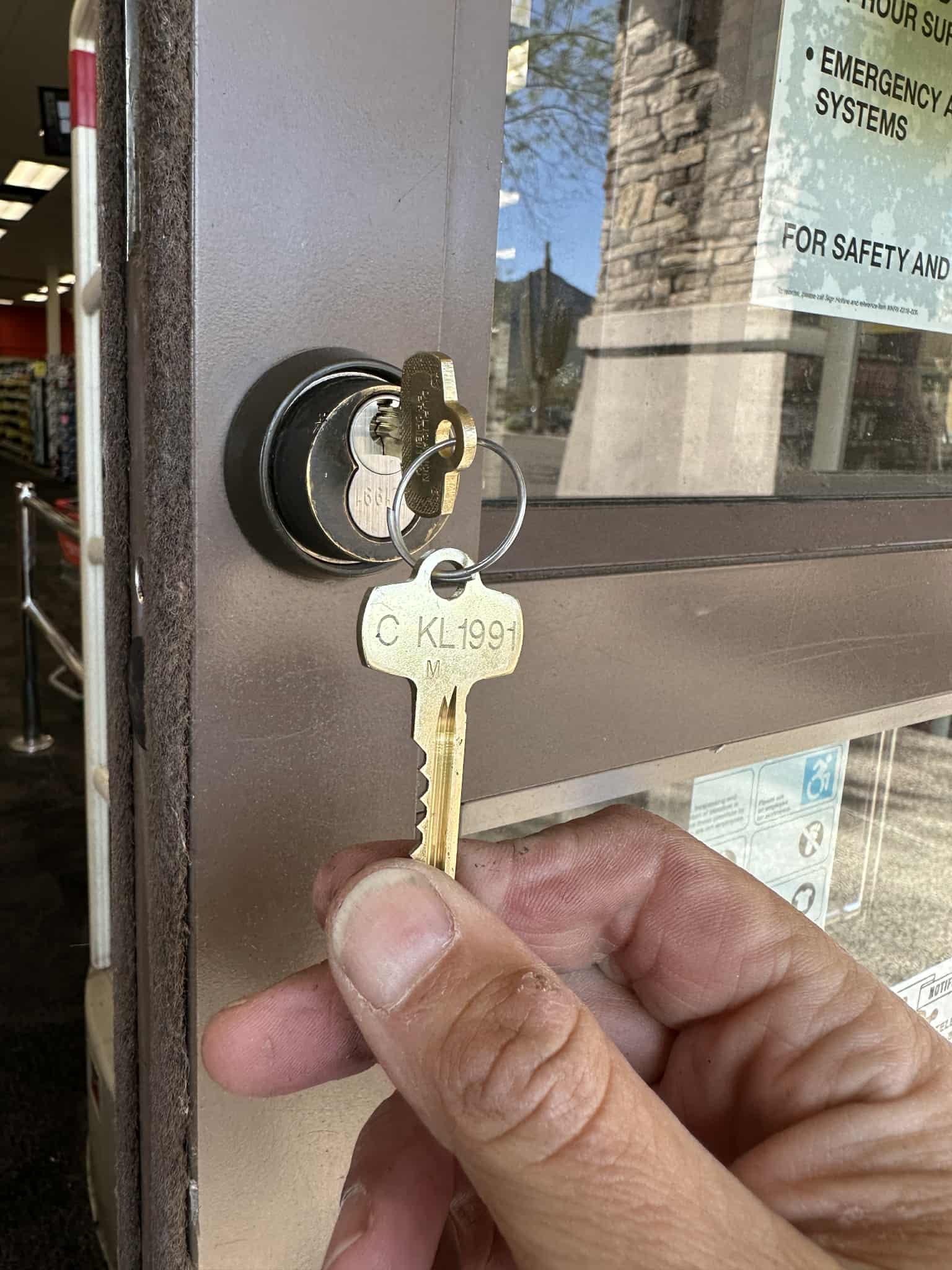
- A brand name stamped or laser-engraved on the key bow (Medeco, Mul-T-Lock, ASSA Abloy, Schlage Primus)
- “Do Not Duplicate” or “Restricted” stamping on the key bow
- Patent notice: “Pat. Pending” or a patent number
- Angled cuts on the key blade (Medeco Biaxial specific)
- A second row of cuts along the side of the blade (Schlage Primus specific)
- A recessed channel running the length of the blade (Mul-T-Lock specific)
- Any key that is noticeably thicker or more complex in cross-section than a standard key
If your key has none of these markers, your lock is likely a standard residential grade, and hardware store copying is mechanically possible (though still not our recommendation for a luxury property; a certified locksmith copy is always more precise).
What to Do If Your Current Keys Were Already Copied at a Hardware Store
Do not panic. Take these steps:
- Inspect the lock cylinder. A certified locksmith can assess pin wear caused by imprecise keys in a 10-minute service call.
- Assess your key control record. Count all existing copies and determine whether any were made at a hardware store.
- Consider a rekey or cylinder replacement. If pin wear is significant or if copies were made outside the authorization chain, rekeying is the correct response. Rekeying a high-security cylinder costs $75–$200 and restores the original security level.
- Rebuild your key control record. Start fresh with a certified locksmith as your sole authorized duplicator going forward.
Call us at Phoenix, AZ (602) 920-2393, and we will walk you through the assessment process at no charge.
Schedule Your Key Duplication or Security Assessment
Phoenix luxury properties deserve security infrastructure that matches their value. A $3 hardware store key copy is not that infrastructure.
North Valley Locksmith provides certified high-security key duplication, lock assessment, master key system installation, and residential security upgrades across Phoenix, Scottsdale, Paradise Valley, Tempe, and the greater Valley area.
Three ways to reach us:
Mail Us | service@northvalleylocksmith.com
Call us Phoenix, AZ, at (602) 920-2393
Visit us: 14202 N Scottsdale Rd Suite 101, Scottsdale, AZ 85254
Follow us for security tips and local news:
Frequently Asked Questions
Can I copy a Medeco key at Home Depot or Lowe’s?
No. Medeco keys use a patent-protected blank with a unique keyway profile that is not stocked by retail hardware chains. Even if a kiosk produced a rough copy using an approximate blank, it would lack Medeco’s sidebar cuts and angled bitting, the features that make the lock function. Medeco duplication requires an ASSA Abloy-authorized dealer, such as North Valley Locksmith.
How much does it cost to copy a high-security key at a certified locksmith?
High-security key copies at a certified locksmith typically cost $35–$95, depending on the brand and keyway. Medeco and Mul-T-Lock blanks carry a higher material cost than standard blanks. For comparison, a hardware store copy costs $5–$15, but it will not produce a working copy of a restricted key. The certified locksmith copy is the only option that is both correct and legal.
What is a “Do Not Duplicate” key, and is the marking legally enforceable?
“Do Not Duplicate” keys fall into two categories. Keys marked DND as a generic instruction have limited enforceability; it is an industry courtesy, not a legal mandate. Keys covered by an active patent are legally protected: duplicating the blank without authorization infringes the patent. Most high-security residential keys (Medeco, Mul-T-Lock, and Schlage Primus) carry active patent protection in addition to the DND marking.
Can a hardware store copy a smart lock key?
Standard smart locks like Schlage Encode and Yale Assure use conventional keyways that can be mechanically copied at a hardware store. However, the copy will not include any electronic credential, only the mechanical backup function. Specialty smart lock keys and access control system keys may use restricted keyways or electronic components that hardware stores cannot handle. A certified locksmith is the safe default for any smart lock key duplication.
Will a hardware store key copy work at first but fail later?
Yes, and this is the most common failure pattern for high-security keys copied on consumer-grade machines. A copy with bitting depths off by 0.004″–0.008″ may operate a lock for weeks or months before the precision pins begin to wear. When the failure finally occurs, the lock cylinder may need to be replaced, not just rekeyed. The delayed failure makes homeowners assume the key was fine when the damage was occurring from day one.
How do I find out if my Phoenix home has high-security locks?
Inspect your current keys for brand markings (Medeco, Mul-T-Lock, ASSA Abloy, or Schlage Primus), “Do Not Duplicate” stamping, or patent notices. Check whether you received a key control card at the time of purchase or move-in. If you are uncertain, call a certified locksmith for a lock identification service; it takes 15 minutes and costs nothing at North Valley Locksmith for Phoenix and Scottsdale homeowners.
Does copying a key at a hardware store void my homeowner’s insurance?
Potentially, yes. Homeowner’s insurance policies that specify security system requirements may include language requiring that restricted key systems be maintained in accordance with manufacturer specifications. Bypassing a manufacturer’s key control program by using an unauthorized duplicator can be cited as evidence of policy non-compliance. Review your policy and consult your agent before allowing any non-authorized duplication.
Can North Valley Locksmith make copies of all high-security keys?
We are authorized dealers for the major high-security brands common in Phoenix and Scottsdale properties, including Medeco, Mul-T-Lock, ASSA Abloy, and Schlage Primus. We carry restricted key blanks in our inventory that are not available at any retail channel. For uncommon or imported lock systems, we can source blanks through our manufacturer network with a lead time of 24–72 hours.
See also: Key Duplication for Scottsdale Commercial Properties | Difference Between Key Duplication and Key Cutting in Scottsdale
About the Author
North Valley Locksmith is a licensed and insured locksmith company based in Scottsdale, Arizona, serving the Phoenix metropolitan area. Our technicians hold current ALOA (Associated Locksmiths of America) certifications and manufacturer authorizations for high-security residential and commercial lock systems. Arizona ROC Licensed. Fully bonded and insured.
14202 N Scottsdale Rd Suite 101, Scottsdale, AZ 85254 | (602) 920-2393 | service@northvalleylocksmith.com