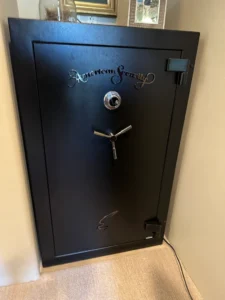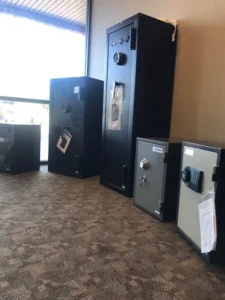
A home safe rarely ends up exactly where it’s easiest to move. It’s upstairs in a closet, down a narrow basement staircase, or wedged into a corner behind furniture that had to go in before the safe did. Safes routinely weigh anywhere from a few hundred pounds to well over a ton. Moving that much weight through a stairwell or a doorway isn’t a job for a dolly and a couple of strong friends. Professionals plan the move before they lift anything. Planning is the real difference between a safe that arrives intact and a safe that damages a staircase, a floor, or a person.
In this article:
- Safe weight and dimensions determine the equipment and crew size needed before the move even starts.
- Stairs, especially basement stairs, are the highest-risk part of most safe moves.
- Tight spaces call for disassembly, alternate routes, or specialized rigging, not brute force.
- Professionals protect floors, walls, and stair treads throughout the move, not just the safe itself.
- Attempting a heavy safe move without the right equipment risks injury, property damage, and a damaged safe mechanism.
Why Moving a Heavy Safe Is a Different Problem Than Moving Furniture
Furniture is bulky but forgiving. It flexes, it has handles, and a dropped edge rarely does serious damage. A safe is the opposite: rigid, dense, and unforgiving if it shifts, tips, or drops even a few inches. A 600-pound gun safe concentrates its entire weight on a small footprint. It places loads that the structures were never built to support directly on the floor, stair treads, and door frames that it passes through.
That density also changes the physics of moving it. A couch that starts to tip can usually be caught. A safe that starts to tip has enough momentum that catching it isn’t realistic. Professional movers plan the path and the equipment before the safe is off the ground, not while it’s already moving.
Assessing the Safe: Weight, Dimensions, and Access Points First
Before any equipment comes out, a professional crew answers a few questions:
- What does the safe actually weigh? Manufacturer specs, a rating plate, or a direct measurement, not a guess. Weight dictates everything: how many crew members we need, and which stair-climbing equipment we can safely use.
- What are the exact dimensions? Door frames, stair widths, and hallway turns all need to be measured against the safe’s footprint, not estimated by eye.
- What’s the planned route, and is there a better one? The shortest path isn’t always the safest one. A wider hallway with one extra turn often beats a narrow direct route.
- What’s the condition of the floors and stairs along that route? Older stair treads, weak subflooring, or tile that could crack under a stair-climbing dolly all change the plan.
Skipping this step is where most non-professional moves go wrong. The crew starts moving the safe, hits an obstacle three steps into the route, and improvises under load. This is exactly when injuries and property damage happen.
Moving a Safe Upstairs or Downstairs
Stairs are the highest-risk part of almost any heavy safe move, and basement stairs are usually worse than a standard staircase because they’re often narrower, steeper, and less structurally reinforced.
Professionals typically use a stair-climbing hand truck or a power-assisted stair climber rated for the safe’s weight, not a standard appliance dolly. These tools mechanically grip the stairs and control descent or ascent at a steady pace, rather than relying on the crew to hold the full weight on each step. On tight or unusually steep stairs, a rigging setup with straps anchored above the stairwell can add a second layer of control, so the safety never depends entirely on the crew’s grip.
Basement moves add another wrinkle: many basement stairways were never designed to handle appliance-scale loads, and a professional crew checks tread condition and stringer support before committing a several-hundred-pound safe to that path.
Handling Tight Spaces: Doorways, Corners, and Narrow Hallways
Not every obstacle is a staircase. Narrow doorways, tight corner turns, and hallways barely wider than the safe itself all call for a different approach than “push harder.”
- Door and trim removal: Pulling a door off its hinges or removing trim can add an extra inch or two, turning an impossible angle into a manageable one.
- Pivoting on a dolly with a pivot plate: Specialized equipment lets the crew rotate a safe in place at a tight corner instead of trying to muscle it through at an angle.
- Disassembly where possible: Some safes have removable doors, shelving, or exterior panels that reduce weight and footprint during the tightest sections of the move, then are reassembled once the safe is in place.
- Rigging through a window or opening: When no interior path works, professionals sometimes route a safe through a window or exterior opening with a crane or hoist, rather than forcing it through an interior space that will never accommodate it.
The common thread across all of these is that the crew changes the plan to fit the space instead of forcing the space to fit the equipment they happened to bring.
The Equipment Professionals Actually Use
A professional safe move typically involves more specialized equipment than most homeowners expect, including the following:
- Rated stair-climbing dollies or power stair climbers, sized to the safe’s actual weight, not a generic moving dolly.
- Safe-specific hand trucks with a low center of gravity and reinforced frames.
- Rigging straps, come-alongs, and anchor points for controlled lowering or lifting, especially on stairs or through openings.
- Floor and surface protection: plywood runners, corner guards, and padding along the entire route to protect floors, walls, and stair treads.
- Pry bars and shims for careful, controlled repositioning at tight turns.
Renting or buying this equipment for a single move rarely makes sense financially, which is part of why most heavy safe relocations go to a professional crew rather than a DIY attempt.
Why This Isn’t a DIY Job
Moving a heavy safe without the right equipment and planning risks three things at once: injury to the people moving it, damage to the property (cracked stairs, gouged floors, dented walls), and damage to the safe itself, including its locking mechanism, which can be knocked out of alignment by a drop or a hard impact that looks minor from the outside.
Professionals carry insurance specifically to cover safe moves, use equipment rated for the load, and have the experience to recognize when a planned route needs to change mid-move. That combination is difficult to replicate with a rented dolly and a group of friends, no matter how strong the friends are.
Signs You Need a Professional Safe-Moving Service
- The safe weighs more than a couple hundred pounds, and you’re not sure how much.
- The move involves any stairs, especially basement stairs.
- The path includes a tight doorway, corner, or hallway that hasn’t been measured against the safe’s dimensions.
- You don’t have access to a rated stair-climbing dolly or rigging equipment.
- The safe is bolted down and needs to be unbolted and reinstalled at the new location.
If any of these apply, the cost of a professional move is small compared to the cost of a damaged staircase, a dented safe, or an injury.
The Bottom Line
Moving a heavy safe up a staircase, down into a basement, or through a tight space isn’t about strength. It’s about planning the route, matching the equipment to the safe’s actual weight and dimensions, and controlling the safe’s movement at every point along the way. That’s the work a professional crew does before the safe ever leaves the ground, and it’s the reason the job gets done without damage to the safe, the property, or the people moving it.
Navigating steep stairs, tight basement turns, or delicate flooring with a multi-hundred-pound safe requires specialized equipment and experienced hands. Protect your property and your back—let the North Valley Locksmith team handle your heavy safe move safely.
Frequently Asked Questions
How much does it cost to move a heavy safe?
Cost depends on the safe’s weight, the distance, and how many stairs or tight spaces are involved. A short, single-story move costs less than one involving basement stairs, disassembly, or rigging through a window. Get a quote based on the safe’s actual specs rather than a general estimate.
Can two people move a heavy safe on their own?
It depends on the weight, but most safes over a couple of hundred pounds need more than manpower alone. Professionals use rated dollies, stair climbers, and rigging equipment because human strength alone can’t safely control a dense, top-heavy object on stairs or through tight spaces.
How do professionals move a safe down basement stairs?
Professionals typically use a power-assisted stair climber or rated stair-climbing dolly matched to the safe’s weight, sometimes paired with rigging straps anchored above the stairwell for extra control. They also check the stair treads and stringers beforehand, since basement stairs aren’t always built for appliance-scale loads.
What happens if a safe gets moved incorrectly?
An improperly moved safe can damage the property (cracked stairs, dented floors, gouged walls), injure the people moving it, or knock the safe’s locking mechanism out of alignment, sometimes from an impact that looks minor from the outside.
Do movers need to remove doors or furniture to move a safe?
Sometimes. Removing a door from its hinges, taking off trim, or clearing furniture from the path can add the extra inch of clearance needed to get a safe through a tight turn. Professionals assess this during the initial route planning, not mid-move.
Is it safe to move a safe through a window instead of a doorway?
Yes, when done professionally. If no interior path can accommodate the safe’s dimensions, movers sometimes use a crane or hoist to move it through a window or other exterior opening rather than forcing it through a space it won’t fit.
See also: Why Gun Safe Moving Should Always Be Left to Professionals in Phoenix, Common Mistakes Homeowners Make When Moving a Heavy Safe