Read time: 10 min | Last updated: June 2026 | Author: North Valley Locksmith Team
63% of all residential break-ins in Arizona involve unauthorized key access. They’re not forced entry, according to the Arizona Department of Public Safety’s 2025 crime data. In Biltmore Estates, where properties routinely exceed $2M and, household staff, contractors, and service vendors cycle through regularly. That statistic is not abstract. It is a floor plan problem. A key control system is the architectural solution. Most Biltmore homeowners do not have one, even if they think they do.
This guide explains what a key control system actually is, how it differs from a standard lock-and-key setup, which systems are suited to luxury residential properties in the Phoenix Biltmore corridor, and what every homeowner in this ZIP code should verify about their current security infrastructure before assuming they are protected.
Written by the licensed team at North Valley Locksmith, Scottsdale and Phoenix’s certified high-security residential locksmith serving the Biltmore, Arcadia, and North Valley areas.
TL;DR — Key Takeaways:
- A key control system restricts who can duplicate your keys, documents every copy ever made, and gives you the legal and technical ability to track and revoke access.
- Standard residential locks bought at a hardware store offer no key control; anyone can copy those keys at any retail kiosk.
- Biltmore Estates properties are prime candidates for high-security key control due to high property values, frequent vendor access, and the complexity of household staff management.
- Patent-protected systems like Medeco, Mul-T-Lock, and ASSA Abloy require authorized dealer duplication; copies cannot be made without the homeowner’s authorization card.
- Rekeying alone is not a key control strategy. Key control prevents the problem that rekeying fixes.
What Is a Key Control System, and What It Is Not
A key control system is a security framework, not just a lock. It combines three elements: a restricted key blank (patent-protected, not available at retail), an authorization protocol (requiring proof of ownership before any duplication), and a documented copy record (a chain of custody for every key in existence).
What it is not: a standard deadbolt, a smart lock app, a lockbox, or a rekey. Each of those tools addresses a specific problem in isolation. Key control addresses the underlying vulnerability, the fact that in a standard residential setup, anyone who holds your key for 60 seconds can have a copy made at a hardware store kiosk with no record, no authorization, and no accountability.
For a Biltmore Estates homeowner with a housekeeper, a pool service, a landscaping crew, a dog walker, a personal chef, and a home renovation project running simultaneously, that vulnerability exists in dozens of parallel chains at once.
How Key Control Systems Work in Practice
The mechanics are straightforward. When you install a key control system:
- Your locks are fitted with cylinders that accept only a restricted keyway, a proprietary blade profile not stocked in any retail channel.
- Your keys are cut from patent-protected blanks supplied only to authorized dealers.
- You receive a key control card, a numbered authorization document tied to your specific keyway. No one can obtain a copy of your key without presenting this card at an authorized dealer.
- Every duplication is logged: who requested it, when, and how many copies were produced.
- If a key is lost or a staff member leaves, you do not need to rekey the entire property. You simply revoke that key number from the authorization record and issue a replacement with a full audit trail.
The result is not just better security. It is documentable security, the kind that satisfies insurance underwriters, estate managers, and luxury property managers who need to demonstrate due diligence on access control.
North Valley Locksmith holds current manufacturer authorizations for Medeco, Mul-T-Lock, ASSA Abloy, Schlage Primus, and Abloy Protec2 and serves the Biltmore, Arcadia, Paradise Valley, and North Scottsdale areas. Call us at (602) 920-2393 or email us at service@northvalleylocksmith.com to schedule a key control assessment.
Why Standard Locks Fail Biltmore Estates Properties
The Biltmore Estates neighborhood presents a specific security profile that standard residential locks are not designed to address. Consider the access variables a typical $3M property in this corridor manages:
- A primary household staff of 2–5 people with keys
- Rotating vendor access (HVAC, pool, landscaping, pest control), often with keys issued informally
- Occasional contractor access during renovation phases
- Family members, extended family, and trusted guests with copies
- Property managers or estate managers with master copies
- Vacation periods during which the property sits unoccupied
Standard Kwikset or Schlage residential locks sold at Home Depot have a key blank that any retail kiosk can copy in 90 seconds. That means any key holder, past or present, can have an unlimited number of copies made with zero documentation and zero accountability to the homeowner.
This is not a hypothetical risk. According to ALOA (Associated Locksmiths of America), residential properties with high staff turnover and frequent vendor access represent the highest-risk category for key proliferation. The gradual, undocumented multiplication of key copies that leaves homeowners with no reliable knowledge of how many keys exist or who holds them.
A key control system eliminates key proliferation by design.
The High-Security Lock Brands Suited to Biltmore Residential Properties
Not all high-security locks are equivalent in their key control capabilities. The following brands are the industry standard for luxury residential key control and are stocked and serviced by North Valley Locksmith in the Phoenix Biltmore area.
Medeco (ASSA Abloy)
Medeco is the most widely specified high-security residential lock in the U.S. luxury market. Its key control program requires presentation of a factory-issued authorization card and government-issued ID before any duplication. The key itself uses a patented biaxial cut, angled bitting at specific rotational positions, that standard key-cutting machines cannot replicate. Medeco’s current patent families cover both the keyway geometry and the sidebar mechanism.
Medeco cylinders are available as deadbolts, knob locks, padlocks, and mortise cylinders, covering every access point in a large residential property. Medeco’s key control documentation is among the most comprehensive in the industry.
Mul-T-Lock MT5+
Mul-T-Lock uses a telescoping pin tumbler system with a secondary locking element, a mechanical complexity that makes picking and bumping attacks significantly more difficult than standard cylinders. The MT5+ key control program restricts blank distribution to authorized dealers and issues numbered authorization cards to homeowners.
Mul-T-Lock is particularly well suited to properties with multiple access points at different security levels, the MT5+ system supports tiered key hierarchies that allow, for example, a housekeeper key to open interior doors but not the primary entry, while a master key covers the full property.
ASSA Abloy High Security
ASSA Abloy’s residential high-security line includes several product families at different price and security tiers. All operate on restricted keyways with documented authorization programs. ASSA Abloy is the parent company of Medeco, Yale, and several other recognized security brands, giving their authorization network significant depth in the Phoenix market.
Schlage Primus / Everest
Schlage Primus adds a secondary set of side bitting cuts to the standard Schlage B-series keyway, cuts that a standard key-cutting machine cannot read or reproduce. The Primus key control program requires dealer authorization for duplication and maintains a registered key record.
Schlage Primus is often specified for properties that want high-security key control without replacing the existing Schlage hardware. The Primus cylinder is retrofittable into most standard Schlage deadbolt housings.
Abloy Protec2
Abloy uses a rotating disc mechanism rather than a pin tumbler, a fundamentally different operating principle that makes it one of the most pick-resistant and bump-resistant cylinders available for residential use. There is no standard key blank for Abloy Protec2; duplication is possible only through the factory-authorized dealer network with documentation.
Abloy is less common in U.S. residential installations but increasingly specified for Biltmore and Paradise Valley properties where clients want European-standard security.
Key Control vs. Smart Locks: How They Work Together
A common misconception among Biltmore homeowners is that a smart lock app eliminates the need for key control. It does not, it shifts the problem to a different access vector.
Smart locks like Schlage Encode, Yale Assure, and August Pro manage electronic credentials: PIN codes, Bluetooth access, and app-based entry logs. These are genuinely useful for managing vendor access (temporary codes, time-limited credentials) and for remote monitoring. But every smart lock also includes a mechanical key override, a physical keyway built into the lock body as a backup. That keyway is usually a standard residential keyway that can be copied at any hardware store.
The smart lock solves the electronic access problem. The key control system solves the mechanical access problem. A complete security architecture for a Biltmore luxury property uses both
- Smart lock credentials for day-to-day vendor and staff management, with time-limited codes and entry logging
- High-security key control cylinders for the physical override keyway, ensuring that the backup access channel carries the same security integrity as the primary one
- A master key system (see below) for internal access hierarchy management
Master Key Systems for Large Biltmore Properties
Properties with 4,000+ square feet and multiple distinct zones. Guest quarters, staff areas, home offices, mechanical rooms, wine cellars, and primary residence benefit from a master key system layered on top of the key control framework.
A professionally designed master key system allows:
- A grand master key that opens every lock on the property (held by the owner only)
- Sub-master keys that open designated zones (housekeeper has access to common areas and guest rooms; does not have access to the owner’s study or vault room)
- Change keys that open only a single lock (pool service has access to the pool equipment room only)
Every tier of the master key system can be built on a restricted keyway, so the key control benefits patent protection, authorized duplication only, and documented copy records apply at every level of the hierarchy.
ALOA’s master key system design guidelines specify that master key systems for properties of this complexity should be designed and installed by a licensed, credentialed locksmith, not assembled from off-the-shelf components.
What Key Control Costs vs. What It Protects
Biltmore Estates homeowners understandably want cost clarity before committing to a security infrastructure upgrade. The numbers are more accessible than most expect.
| Component | Typical Cost Range | Notes |
|---|---|---|
| High-security cylinder (per lock point) | $85–$250 | Varies by brand and cylinder type |
| Full property cylinder replacement (5–10 lock points) | $600–$2,500 | Installed and keyed by certified locksmith |
| Master key system design and installation | $400–$1,200 | Depends on number of zones and key hierarchy levels |
| Key duplication (authorized, per copy) | $35–$95 | Versus $5–$15 at hardware store,uncopyable without authorization |
| Annual security audit and key control review | $150–$350 | Recommended annually for properties with active staff rotation |
| Total first-year investment (typical Biltmore property) | $1,500–$5,000 | |
| Value protected (median Biltmore Estates home) | $2.5M–$6M+ | Per Maricopa County assessor data, 2025 |
The ratio is unambiguous. The annual cost of a maintained key control system represents less than 0.1% of the asset value it protects.
For context, a single homeowner’s insurance claim denial following a burglary, citing inadequate key control as evidence of negligence, can represent six figures of uncompensated loss. Several major carriers writing luxury homeowner policies in Arizona include security system maintenance clauses that reference key control compliance.
Choosing a Locksmith for Key Control in the Biltmore Area
Not every locksmith is authorized to install and service high-security key control systems. The authorization matters for two reasons: legal and technical.
Legal: Patent-protected key control systems require dealer authorization from the manufacturer. A locksmith without current authorization cannot legally obtain the restricted blanks necessary to issue keys under your system.
Technical: Code-cutting for high-security keys requires equipment and training that general locksmith operations lack. The tolerances involved, ±0.001 inches versus the ±0.010 inches of standard key cutting, are not achievable on consumer-grade equipment.
When evaluating a locksmith for key control work on a Biltmore property, verify:
- Current ALOA certification (Certified Registered Locksmith or higher)
- Manufacturer authorization for the specific brands you are installing (ask for documentation)
- Arizona ROC license and current bond and insurance
- Experience with residential master key systems at a comparable property scale
- A written duplication policy and key control record-keeping process
Schedule Your Biltmore Key Control Assessment
A key control system is not an upgrade. It is the baseline security infrastructure that a property of this value requires.
North Valley Locksmith provides certified key control system installation, master key system design, high-security cylinder upgrades, and residential security assessments across the Phoenix Biltmore corridor and greater Valley area.
Reach us three ways:
Mail Us | service@northvalleylocksmith.com
Call us Phoenix, AZ, at (602) 920-2393
Visit us: 14202 N Scottsdale Rd Suite 101, Scottsdale, AZ 85254
Follow us:
See also: Why Luxury Homeowners in Phoenix Should Never Rely on Hardware Store Key Copies | Key Duplication for Scottsdale Commercial Properties
Frequently Asked Questions
What is the difference between a key control system and just rekeying my locks?
Rekeying changes the internal pin configuration of your existing lock so that old keys no longer work. It is a reactive measure; you rekey after a key is lost or after a staff member leaves. A key control system is a proactive framework that prevents unauthorized duplication from the start. It uses patent-protected, restricted key blanks that cannot be copied at any hardware store, combined with an authorization protocol that requires your sign-off before any new copies are made. Rekeying fixes the problem. Key control prevents it.
Can I use a key control system alongside my existing smart lock setup?
Yes, and for Biltmore properties, this is the recommended configuration. Smart locks manage electronic credentials: PIN codes, app access, and time-limited vendor codes. Every smart lock also has a physical key override, and that keyway is typically a standard blank copyable at any retail kiosk. Installing a high-security key control cylinder in your smart lock’s physical keyway closes that vulnerability. The result is layered security: electronic access management on top, mechanically protected backup below.
How do I know if my current Biltmore home already has a key control system installed?
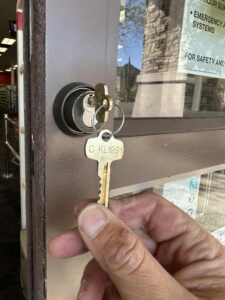
Inspect your keys. A key control system key will carry a brand marking (Medeco, Mul-T-Lock, ASSA Abloy, or Schlage Primus), a “Do Not Duplicate” or “Restricted” stamp, or a patent notice. You should also have received a key control card, a numbered authorization document, at the time of purchase or installation. If your keys are unmarked and you do not have an authorization card, your property does not currently have a key control system. A certified locksmith can confirm the cylinder type in a 15-minute walkthrough.
What happens if I lose my key control authorization card?
Losing the authorization card does not lock you out of your home; it affects your ability to request additional key copies from the authorized dealer network. The recovery process depends on the manufacturer. Medeco, for example, requires the homeowner to contact their authorized dealer and provide proof of property ownership to issue a replacement card. The process typically takes 5–10 business days. If the card has been lost for an extended period and key control integrity is uncertain, the secure response is to install new cylinders under a fresh key control registration.
How many copies of a key control key should I have for a large Biltmore property?
The number of copies should match the number of active, verified key holders and no more. A common framework for a large Biltmore property: two owner copies (primary and backup in a secure location), one estate manager copy if applicable, one copy per long-term household staff member with documented access rights, and zero copies for vendors (vendor access should be managed via smart lock temporary codes, not physical keys). Every copy should be numbered, logged against a named holder, and reviewed annually. If a copy cannot be accounted for, treat it as lost and rekey.
Can previous owners or contractors still access my Biltmore home if the key control system was installed before I purchased it?
Only if they hold a valid key and the cylinders have not been changed since their authorized access was established. When purchasing a property with an existing key control system, the correct move is to request a full rekey to a new keyway under your own key control registration before moving in. This terminates all previous key holders’ access and starts a clean authorization record in your name. North Valley Locksmith handles this as part of our residential security changeover service for new Biltmore homeowners.
Are key control systems worth the cost for a vacation home or part-time Biltmore residence?
Yes, in fact, the risk profile for a part-time residence is higher, not lower, than a primary residence. Vacation homes and seasonal properties sit unoccupied for extended periods, during which access management is often delegated to property managers, caretakers, and vendors without close oversight. Key proliferation risk is highest in low-oversight environments. A key control system with a small, documented set of authorized key holders is the most cost-effective way to maintain access integrity during long periods of inactivity. The cost of a key control system is modest compared to the cost of discovering unauthorized entry into a vacant $4M property.
What is a master key system, and does my Biltmore property need one?
A master key system creates a hierarchy of keys that open different combinations of locks on the same property. A grand master opens every lock. Sub-master keys open designated zones — a housekeeper’s key might access common areas and guest rooms but not the owner’s study or wine cellar. Change keys open a single lock only. For Biltmore properties with 4,000+ square feet, multiple access zones, and active staff, a master key system built on a restricted keyway gives you precise, zone-level access control without issuing a full-property key to anyone except the primary owner. North Valley Locksmith designs and installs master key systems layered on high-security key control platforms for properties across the Biltmore and greater Phoenix area.
How often should I audit my key control system?
Annually is the standard recommendation for active Biltmore residences and after every significant access event: staff departure, contractor project completion, household transition, or any period where key accountability was uncertain. An annual audit with a certified locksmith involves reviewing the key copy record, confirming every copy’s current holder, inspecting cylinders for wear, and verifying that smart lock access logs show no anomalous events. The audit typically takes 60–90 minutes and costs $150–$350 depending on property size. It is the single highest-ROI security maintenance task for a luxury property.
Does North Valley Locksmith service the Biltmore Estates area?
Yes. North Valley Locksmith serves the Biltmore Estates neighborhood and the broader Phoenix and Scottsdale area, including Arcadia, Paradise Valley, Old Town Scottsdale, Troon North, DC Ranch, and the North Valley corridor. We hold current manufacturer authorizations for Medeco, Mul-T-Lock, ASSA Abloy, Schlage Primus, and Abloy Protec2, and our technicians are ALOA-certified with experience in luxury residential key control and master key system design. Contact us to schedule a no-obligation key control assessment at your Biltmore property.
About the Author
North Valley Locksmith is a licensed and insured locksmith company based in Scottsdale, Arizona, serving the Phoenix metropolitan area, including the Biltmore Estates, Arcadia, Paradise Valley, and North Scottsdale communities. Our technicians hold current ALOA certifications and manufacturer authorizations for high-security residential and commercial lock systems. Arizona ROC licensed. Fully bonded and insured.